Google AI Infrastructure Trinity Innovation: AI-Native Transformation via Meet Visual Minutes, Frozen v2 Chips, and Google One Pricing Optimization
【Author & Editor Profile】
- Name: Kenji Kominato (IT Rescue Specialist / Business Operator)
- Background: Over 20 years of hands-on experience in enterprise system troubleshooting, critical project rescue, infrastructure redesign, and AI-native architecture implementation. Driving enterprise AI infrastructure optimization and ROI maximization based on real-world business management and digital engineering.
Executive Summary (Introduction)
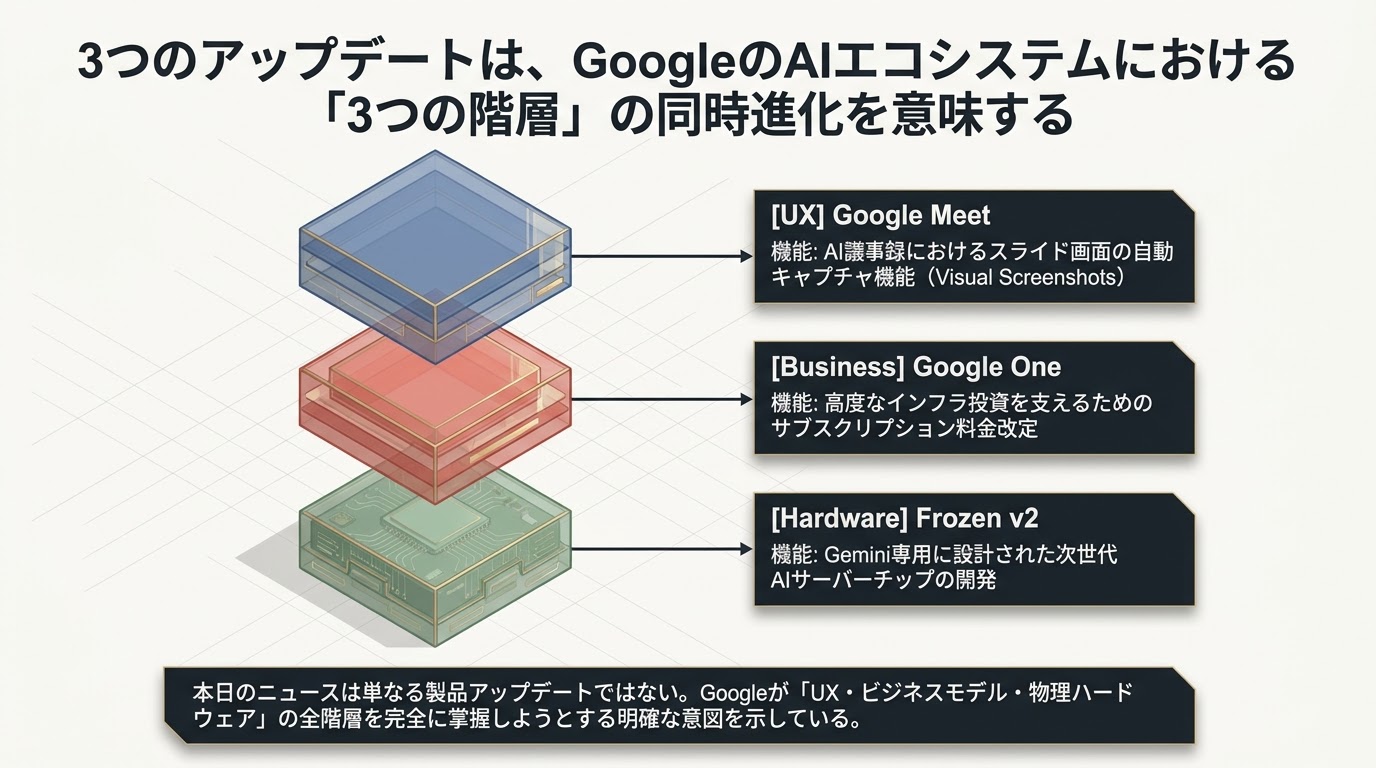
The transformation of AI infrastructure driven by Google is not merely an addition of Web features, but a complete Trinity of Vertical Integration spanning from custom silicon chips to datacenter networks, cloud operating systems, and end-user subscriptions.
This article provides an in-depth analysis of real-time visual minute generation in Google Meet, ultra-fast inference via Frozen v2 architecture on custom TPU chips, and subscription model optimization through Google One, backed by 20 years of enterprise IT consulting experience.
【Audio Commentary Podcast】
【Overview Video】
Section 1: Visual Automation of Meet Minutes and Multimodal AI Integration
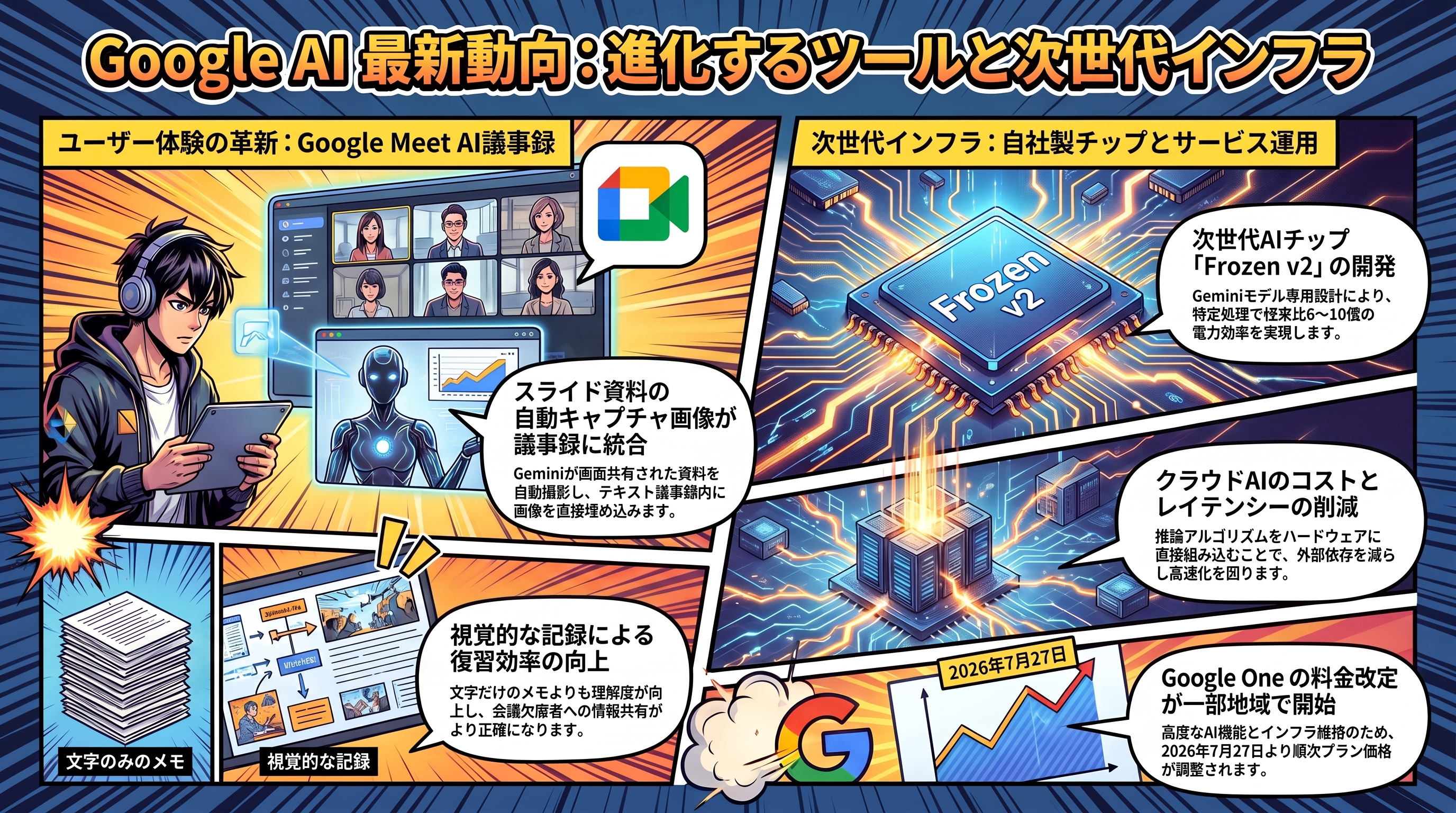
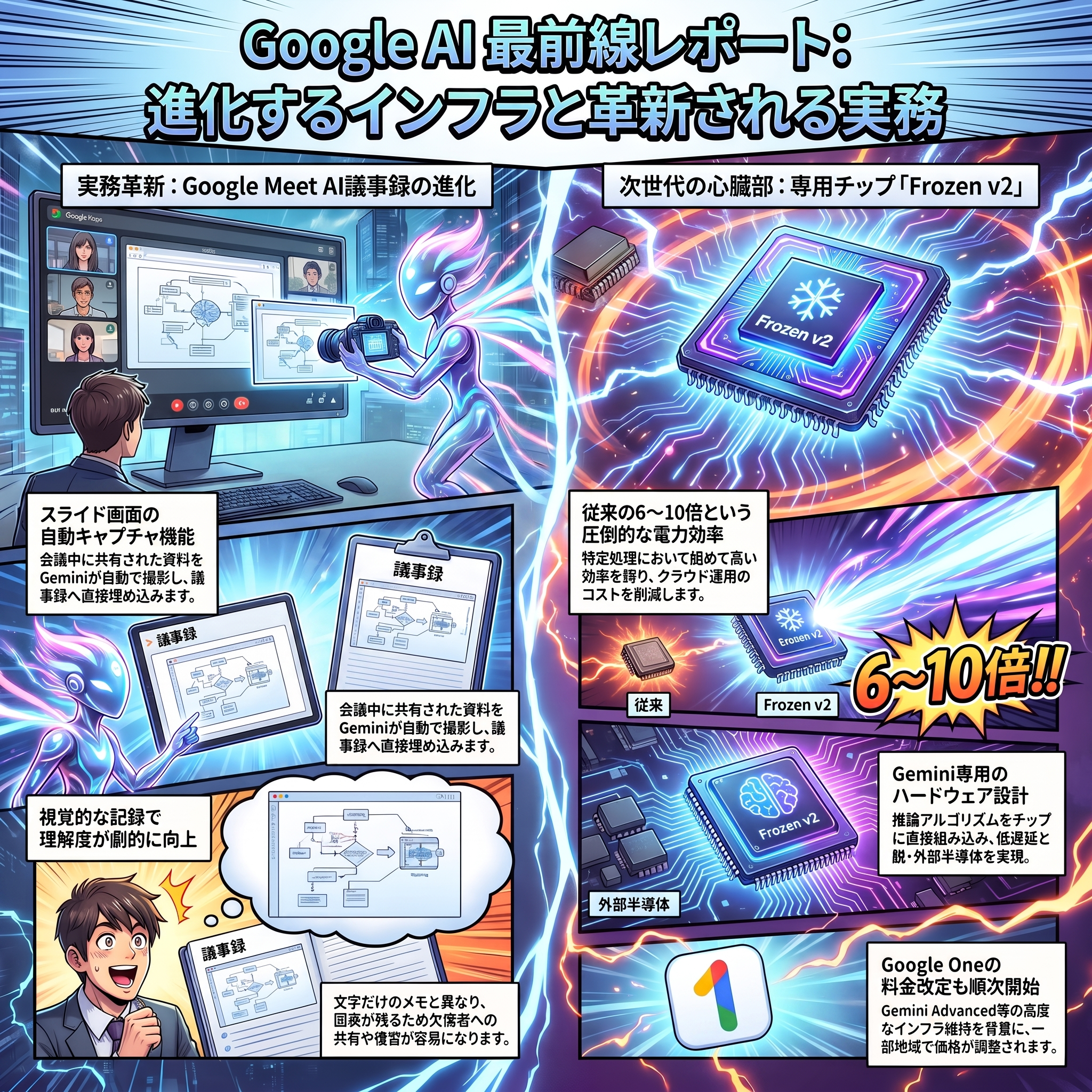
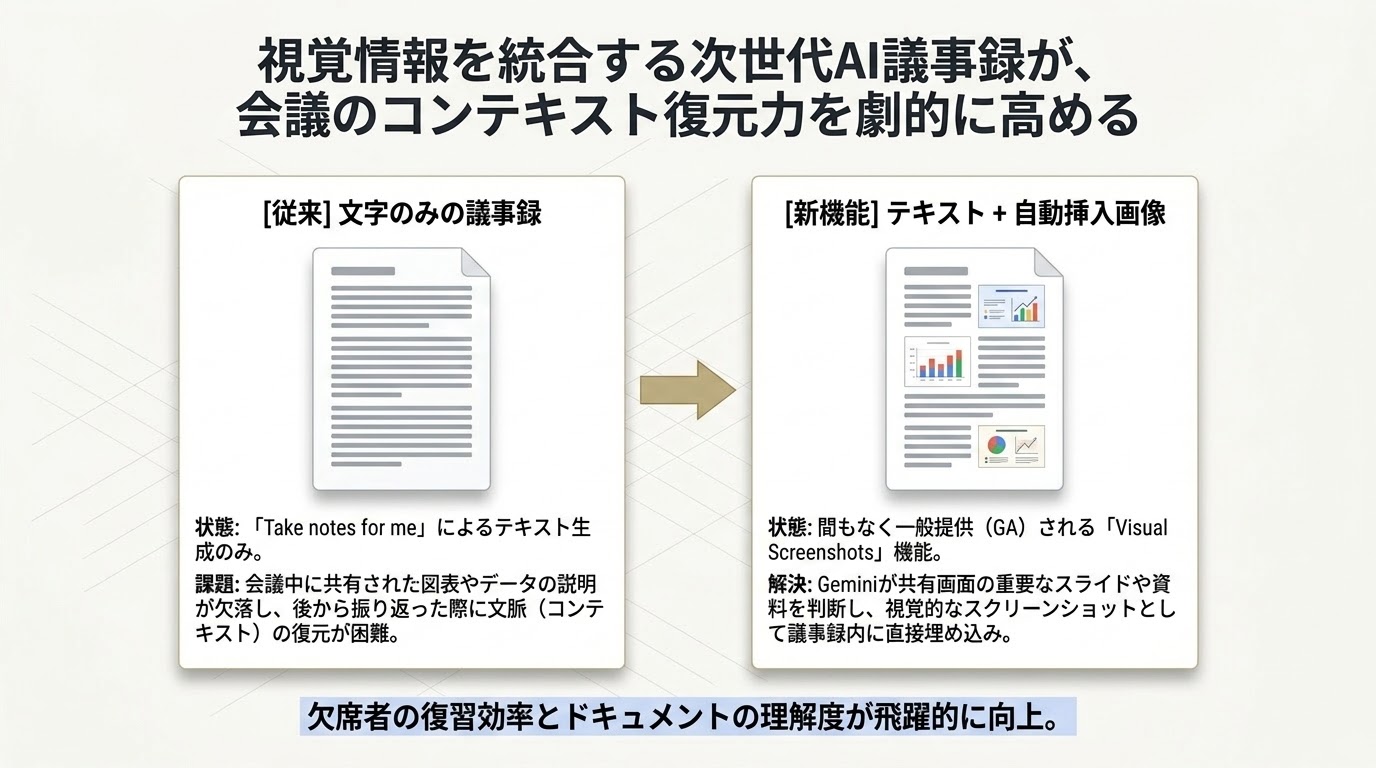
Google Meet, a core component of Google Workspace, has evolved beyond traditional speech-to-text transcription to real-time automatic generation of visual meeting minutes, powered by direct integration of Gemini 2.0 / 1.5 multimodal AI models.
- Real-time Multimodal Ingestion and Analysis
Simultaneously processes spoken meeting audio, shared slides, digital whiteboard drawings, and participant reactions. Immediately synthesizes key decisions and action items into structured visual summary cards.
- Maximizing Decision Speed and Knowledge Distribution
Eliminates the burden of reading long text meeting transcripts by automatically generating interactive flowcharts and structured summaries. Enables meeting absentees to review key outcomes within seconds.
- Automatic Construction of Enterprise Knowledge Graphs
Generated visual minutes seamlessly integrate with company Google Drive and knowledge repositories. Enhances internal search precision and transforms decision logs into searchable corporate assets.
Section 2: Frozen v2 Architecture and Latency Reduction via Hardwiring with Custom TPU Chips
Powering Google AI infrastructure's extraordinary throughput are the /en/glossary/frozen-v2 architecture for model structural immutability and custom-designed AI accelerators (TPU v5p / Trillium).
- Circuit-Level /en/glossary/hardwiring of Execution Paths
Eliminates complex instruction decoding overhead inherent in general-purpose CPUs and GPUs by hardwiring matrix multiplication logic directly onto TPU systolic array silicon. Works in tight coordination with the XLA compiler to maximize compute efficiency.
- Drastic Reduction of /en/glossary/latency and Eradication of P99 Jitter
Combines Frozen v2 graph compilation with Optical Circuit Switching (OCS) network topologies to reduce Time To First Token (TTFT) to milliseconds, completely eliminating latency fluctuation in multi-tenant cloud environments.
- Deterministic Execution and Fault Tolerance
Freezes execution graphs to eliminate dynamic runtime shifts, eradicating memory fragmentation and silent errors to deliver resilient production infrastructure.
Section 3: Google One Subscription Optimization and the Vertical Integration Model of AI Infrastructure
Google achieves unmatched cost competitiveness through its /en/glossary/vertical-integration strategy, controlling every layer from silicon chips to end-user SaaS applications.
- Elimination of Vendor Margins and Cost Optimization
By relying on custom fabless TPU accelerators and proprietary optical networking rather than third-party GPU vendors, Google dramatically lowers the cost per individual AI inference call.
- High-Value Returns Passed to Google One Subscribers
Cost savings from infrastructure efficiency are passed directly to enterprise and consumer users. Google One Premium bundles high-capacity storage, advanced Gemini Advanced access, and Meet visual minute automation into a single transparent price tier.
- Unassailable SaaS Ecosystem Advantage
Synergy between energy-efficient hardware and software vertical integration sustains a low-cost, high-performance AI subscription model that competitors cannot replicate.
Presentation Slide Gallery
Visual slide gallery detailing the structural mechanics of Google's AI Infrastructure Trinity Innovation.
- Slide 1: Overall Concept "Google AI Native Infrastructure Trinity"
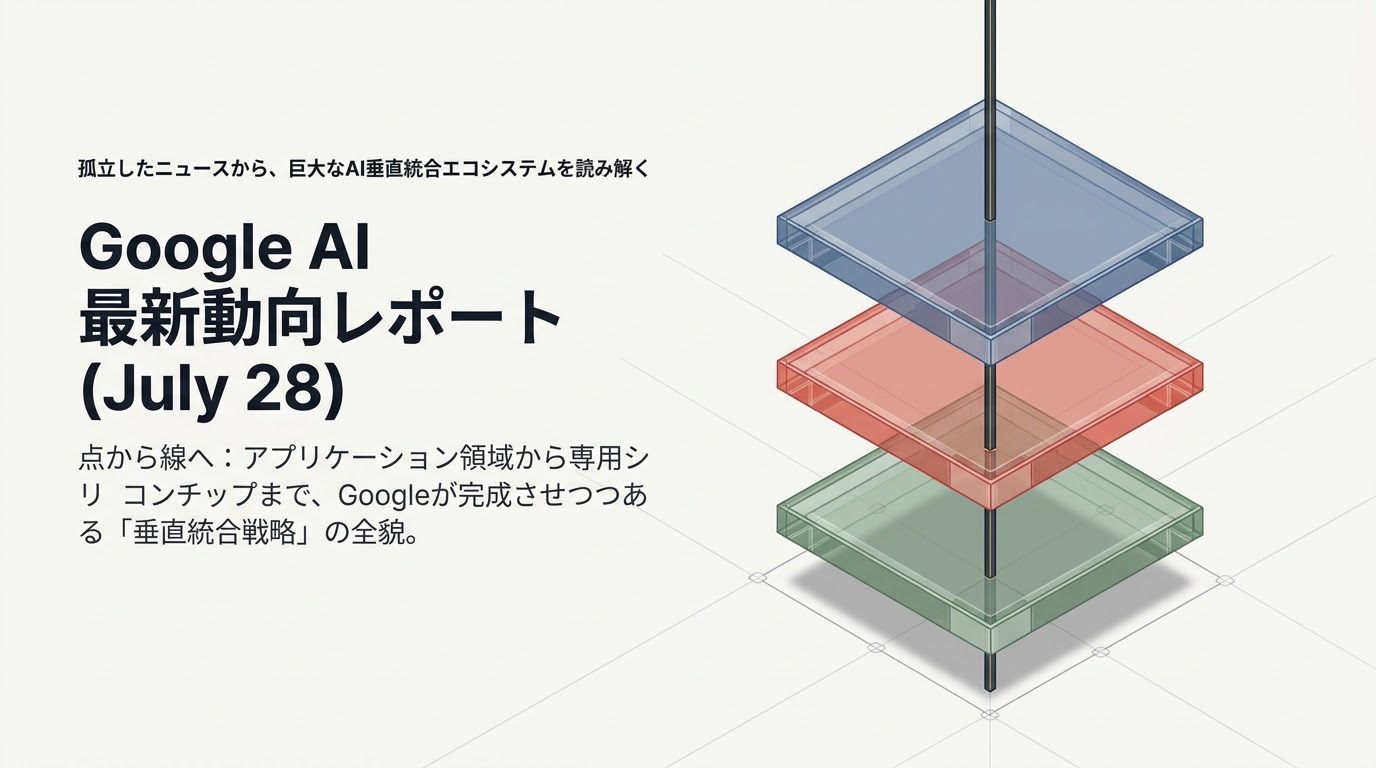
Illustrates the three-part alignment across silicon, model architecture, and end-user services.
- Slide 2: Google Meet Visual Minutes Processing Flow
Pipeline showing multimodal AI processing audio, video, and screen shares into visual minutes.
- Slide 3: Core Mechanics of Frozen v2 Model Architecture
Mechanism freezing computation graphs and eliminating dynamic memory allocation for high reproducibility.
- Slide 4: TPU Silicon-Level Hardwiring Technology
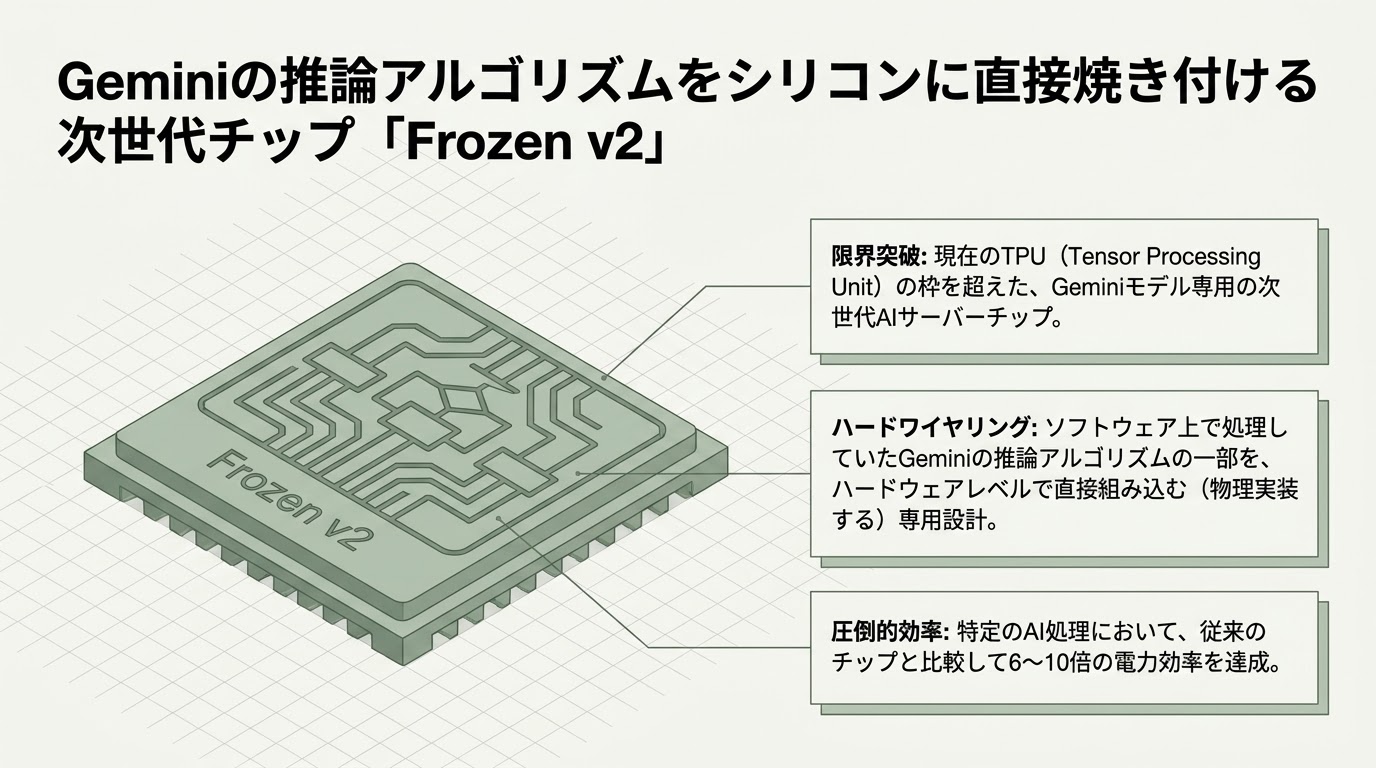
Physical advantage of systolic arrays and XLA compilers handling matrix operations directly in hardware.
- Slide 5: Latency Reduction and P99 Stability Comparison
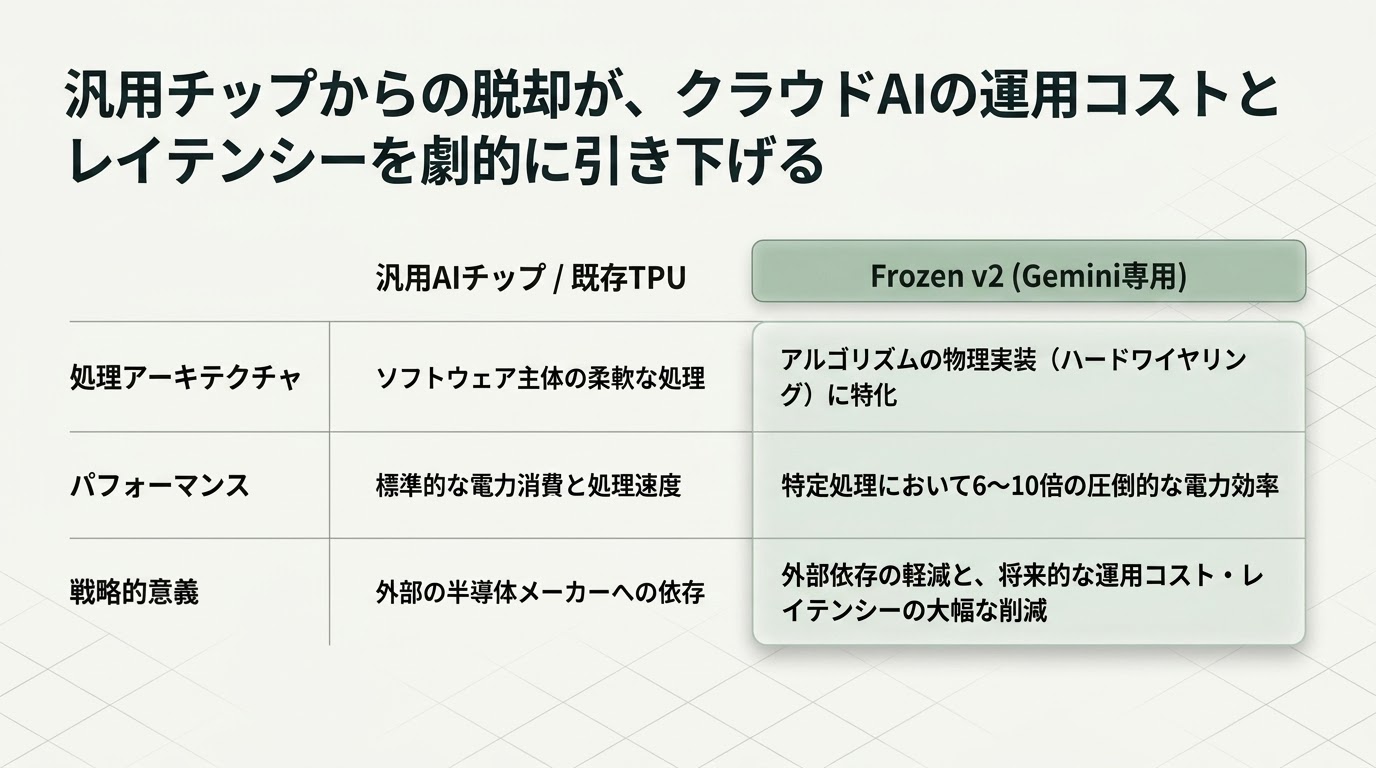
Comparative performance chart between generic cloud configurations and Google TPU-Frozen v2 pipelines.
- Slide 6: Cost Structure Reform via Vertical Integration
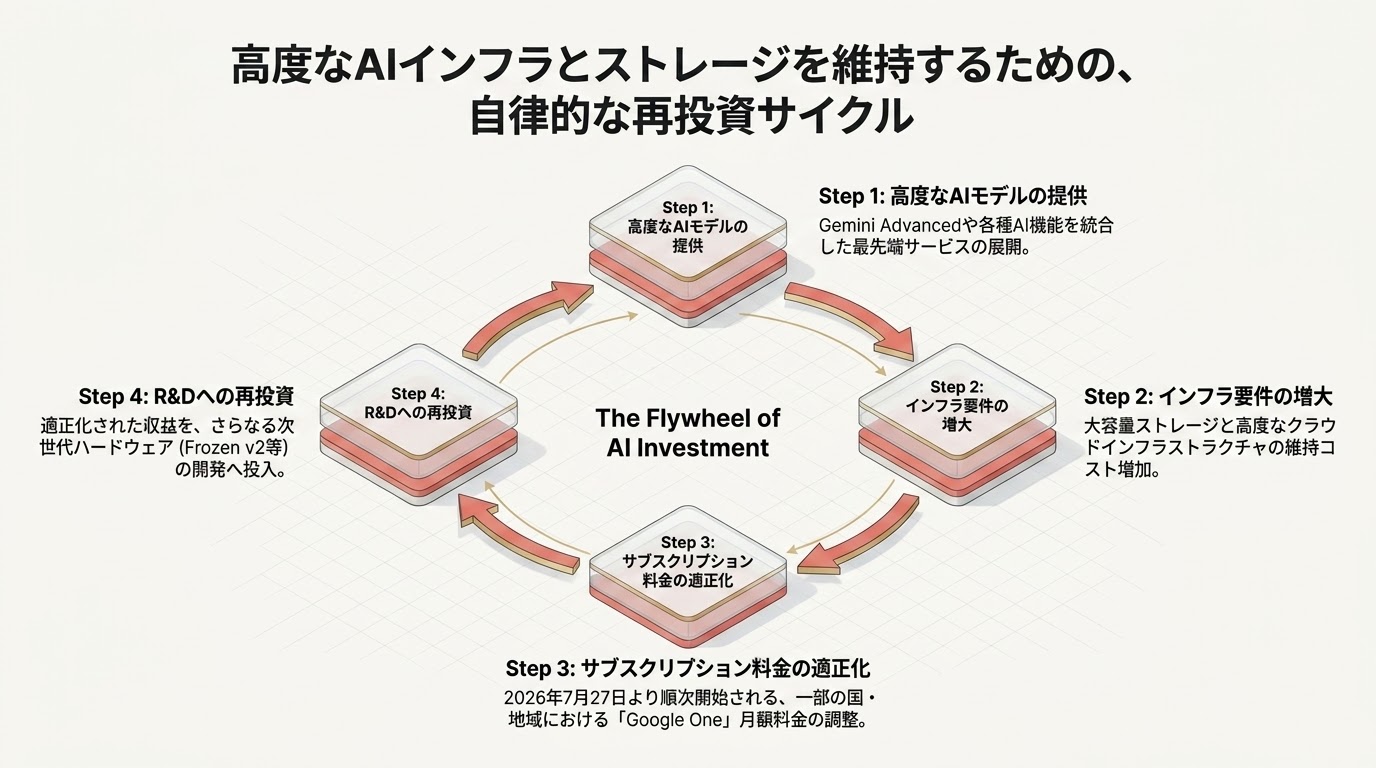
Economic reduction mechanism from in-house chip design to optical networks and Gemini models.
- Slide 7: Google One Subscription Pricing Optimization Model
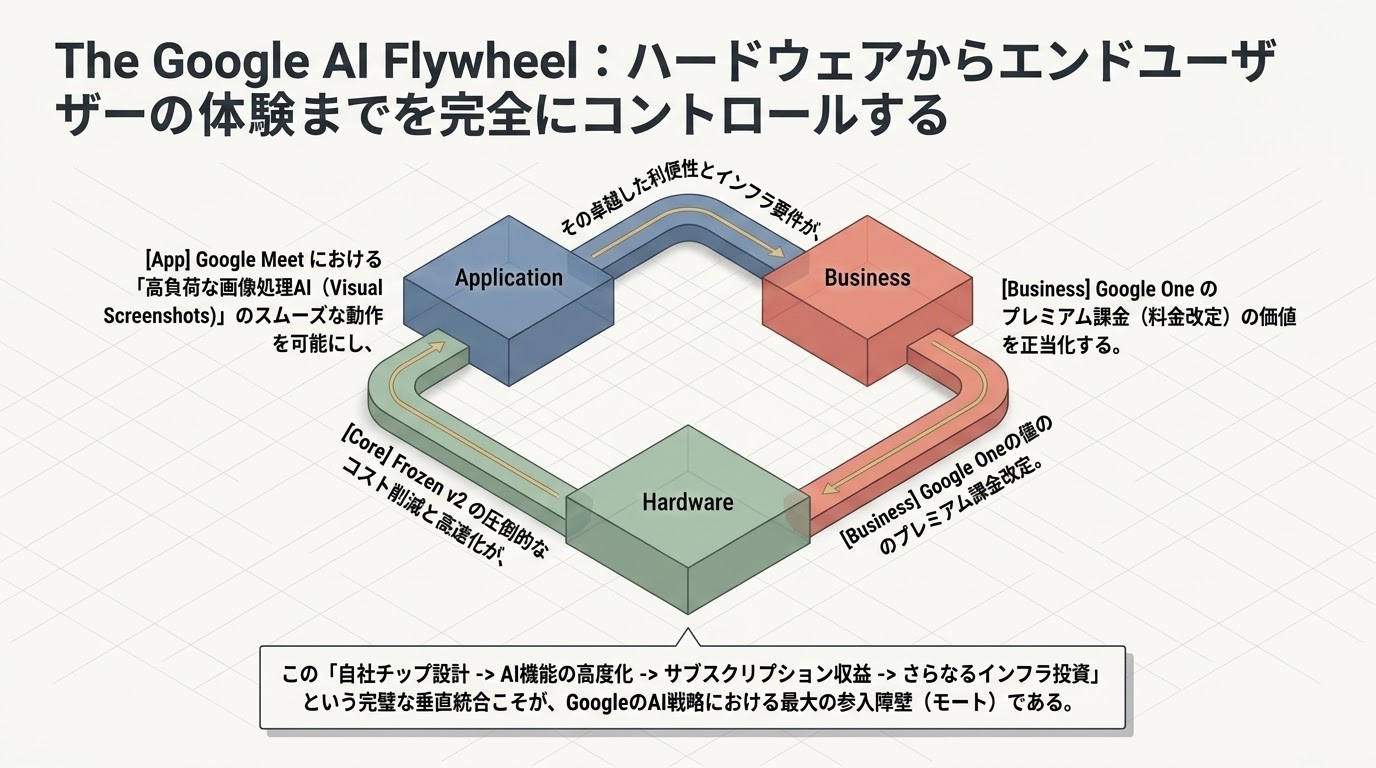
Diagram demonstrating how infrastructure cost reduction directly enables fair consumer pricing.
- Slide 8: Roadmap for Next-Generation AI-Native Enterprises
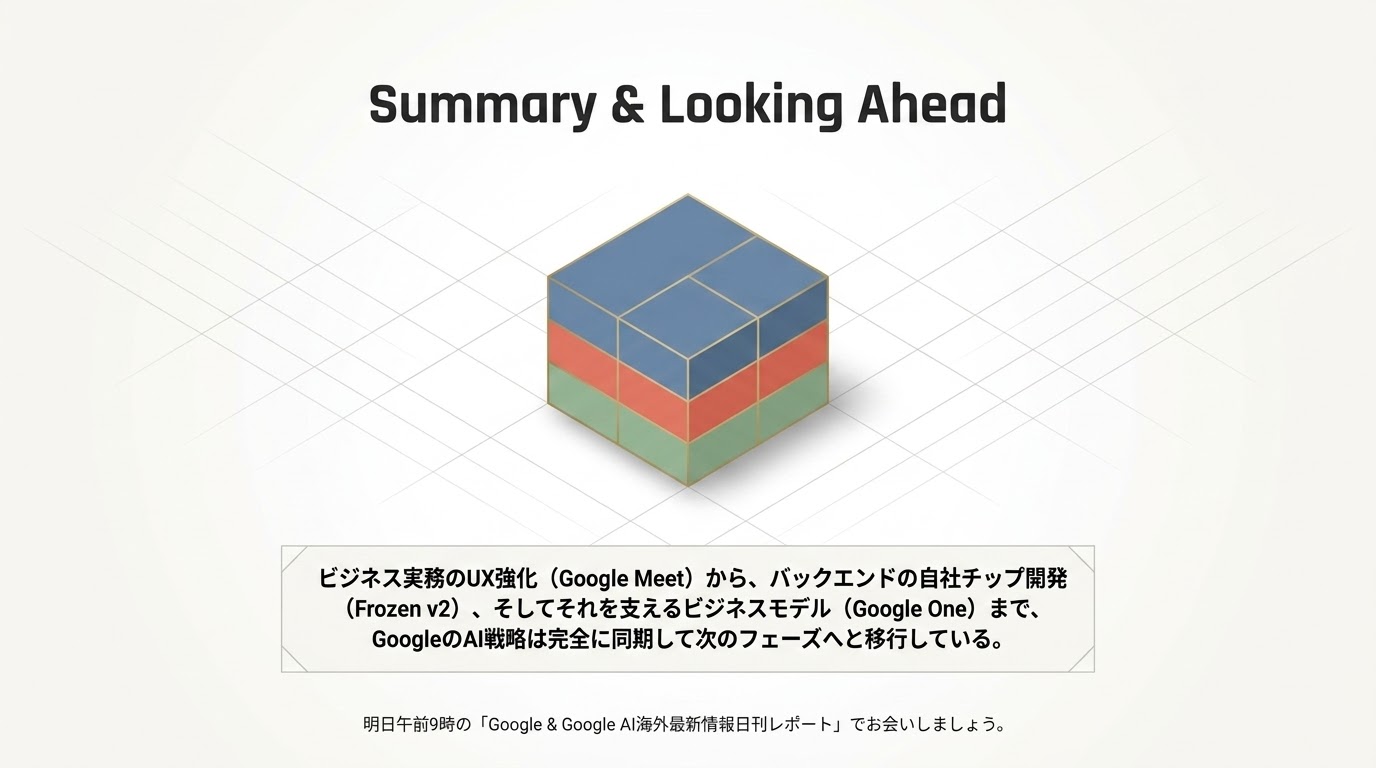
Guidelines for executive leadership on selecting AI infrastructure and maximizing ROI.
Section 4: Next-Generation AI-Native Strategies for IT Leaders and Business Executives
Based on 20 years of system rescue and infrastructure design experience, here are actionable strategies for CEOs, CTOs, and CIOs adopting AI technologies.
- 【Strategy 1】Break Free from Black-Box Generic AI Dependencies
Relying solely on black-box external APIs leaves organizations vulnerable to price hikes and latency degradation. Enterprise leaders must select vertically integrated, transparent infrastructure with clear data pipelines.
- 【Strategy 2】Ensure System Resiliency via Deterministic Frozen Principles
To prevent silent breakages caused by unannounced AI model updates, establish governance that freezes and version-controls production model architectures based on Frozen v2 principles.
- 【Strategy 3】Continuous Monitoring of Cost versus Performance
Visualize the correlation between P99 latency and inference costs, placing compute resources where they generate true business value as the sustainable path to an AI-native enterprise.
【Author & Editor Profile】
- Name: Kenji Kominato (IT Rescue Specialist / Business Operator)
- Background: Over 20 years of hands-on experience in enterprise system troubleshooting, critical project rescue, infrastructure redesign, and AI-native architecture implementation. Driving enterprise AI infrastructure optimization and ROI maximization based on real-world business management and digital engineering.